Show What You Know the Rock Cycle Worksheet Answers
Feedback archive → Feedback 2016
The rock cycle
How practice we handle it?
Published: eight October 2016 (GMT+ten)
Today'due south feedback comes from Dan B. of the UK, who asked for help nigh the geological rock wheel in his daughter'south schoolhouse curriculum.

We've just received the science curriculum my girl will exist following as she moves into Twelvemonth eight (i.east. when students turn 13 in the UK school organization). It includes the topic of the "rock bike" to which a few CMI manufactures brand passing references merely none appear to give explicit treatment. It seems to be a central concept in long-age historical geology. How should Christians think biblically about it, and how might parents best handle it with their children every bit they are taught it at school? Is it one to which we can give qualified express assent, except that it involves excessive extrapolation into the past? I was never taught any geology in school scientific discipline, including A-level physics and chemistry. Yet here is this concept introduced at an earlier stage, before any curricular discussion of biological evolution.
CMI geologist Tasman Walker responds:
Hi Dan,
Yes, the rock bicycle is a key concept in long-age 'historical' geology. As you discovered, geological concepts are introduced to students early on in the curriculum within the long-age worldview. By presenting the rock bicycle in a long-age framework naturally prepares students for other evolutionary ideas.
These slow, endless cycles Hutton imagined are similar to the Hindu concept of eternal cycles of nature.
The rock cycle is like many other concepts related to development and long ages. There are some aspects of the 'bicycle' that are reasonable, which can exist supported, and there are other aspects that involve eons of time, which need to exist recognized and reinterpreted.
The original rock-bike concept is credited to the Scottish physician James Hutton (1726–1797), who is regarded as a founder of modern, long-age geology. (See articles on Hutton, on The Human being Who Found Time and Siccar Bespeak.) The aim of the bike is to describe the relationship between the three basic rock types: igneous, sedimentary, and metamorphic. In that location are many versions of the stone-cycle concept around these days.
Many cycles be in the natural world, such as the water cycle, the life cycles of insects, of other animals, and the nitrogen wheel. These cycles operate over periods of weeks, months and years, and as such tin can be observed and studied. The stone cycle, on the other hand, is envisaged to operate over timescales of millions of years, and every bit such information technology cannot exist observed. The validity of the other cycles tends to give the long-age rock cycle brownie and implies that information technology is however operating, but information technology is not.
The effigy at right shows a typical version of the rock bicycle. It has a box for each type of rock, "Igneous rock", "Sedimentary rock", and "Metamorphic stone". Likewise shown is a box for "Sediment", which is a pace on the style to sedimentary stone, and "Magma", or molten stone, which is a step on the way to igneous stone.
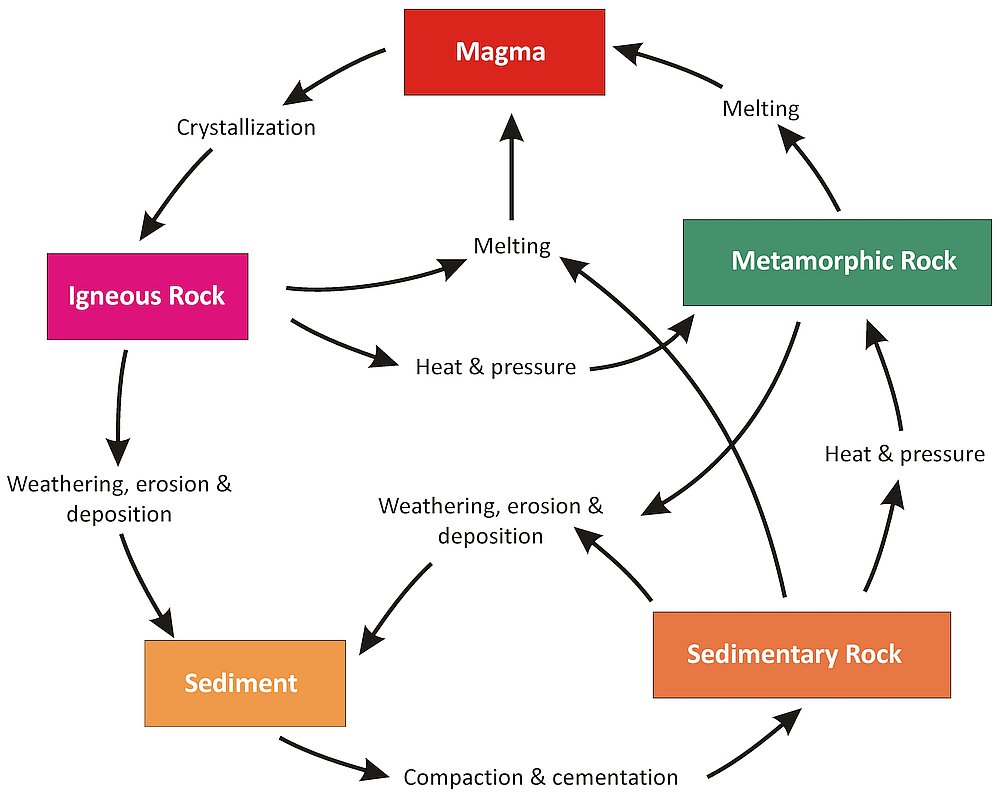
This diagram shows how each kind of rock tin change into other kinds of rock:
- Sedimentary rock can change into metamorphic rock, igneous stone, or even different sedimentary rock. The procedure of alter is weathering, erosion, degradation, compaction and cementation.
- Igneous rock can modify into sedimentary stone, metamorphic stone, or even unlike igneous rock. The process of change is melting and crystallization.
- Metamorphic stone can change into sedimentary rock, or igneous stone. It can as well change into different metamorphic rock but this is non shown on the diagram. The metamorphic change is driven past heat and pressure.
The basic philosophy of long-age geologists is that the rocks of the earth formed under conditions similar to what nosotros come across on globe at the nowadays time. Consequently the diagram mentions processes that we see happening today. For example, nosotros see rocks weathering and eroding and producing sediment. We see sediment cementing into sedimentary stone. We see magma erupt from volcanoes and crystallize into rock. These processes are reasonably pocket-size-scale compared with the size of the world, and do non have much geological impact. Consequently, to produce the enormous volume of rock we come across on the earth, James Hutton assumed that geological processes continued over eons of time. That is why he imagined the world was infinitely old.
So, the stone bicycle suggests rocks go along changing from 1 form into some other in endless cycles, going on and on forever. James Hutton said that he saw "no vestige of a offset and no sign of an end". These ho-hum, countless cycles Hutton imagined are similar to the Hindu concept of eternal cycles of nature.
The stone bicycle has been modified since Hutton first proposed it. Developments in thermodynamics in the late 1800s meant that the bike could not have been going on endlessly, but it is nonetheless considered to accept operated for eons of time. With the advent of plate tectonics in the 1960s the repetitive rock cycle changed into a gradually evolving process.
Geologists who brainstorm with the Bible have a dissimilar style of understanding the geology of the world. Nearly take concluded that, at a minimum, most of the fossil-bearing rocks on the earth formed during the year-long Noah's Overflowing. (See The geological column is a general Flood lodge with many exceptions.) In other words, most of the rocks on earth formed chop-chop, inside that year-long issue. (Some biblical geologists consider that some rocks on the World formed during Creation Week, and equally a effect of regional catastrophes in the years immediately later on the Overflowing, merely these too would have formed quickly.)
From a biblical perspective the processes indicated on stone cycle were rapid.
Therefore, from a biblical perspective the processes indicated on the rock cycle were rapid, and formed mostly in catastrophic events, especially the year-long Flood. Rocks melted and crystallized into igneous rocks. This happened quickly. Rocks were cached and metamorphosed; this besides happened quickly. Rocks were eroded, transported, and deposited as sediment, which was so compacted and cemented into rock. This also all happened quickly.
The term "weathering" on the diagram is non appropriate because it implies slow disintegration of rocks due to the weather. However, the rocks would have eroded very rapidly during the Inundation (and on a smaller calibration in post-Flood catastrophes) by processes such every bit cataclysmic water flows. Weathering as we know information technology today is only valid in the c. 4,000 years since the Overflowing and the firsthand post-Flood era, and this has only had a tiny comparative effect on the geology.
And so, we tin support the idea that rocks changed from one into the other, just this mostly happened during Creation Calendar week, the year-long Alluvion, and (on a smaller calibration) in mail service-Flood regional catastrophes. We tin take the geological processes of erosion, deposition, compaction, cementation, melting, crystallization, and metamorphism (due to rut and pressure). We would not accept "weathering" every bit a significant process explaining well-nigh of the rock record, simply we take that it has occurred since the Flood. Nosotros can accept that there were multiple 'cycles' that would take occurred during the year-long Flood. These would have been driven by movements of the earth'due south crust and enormous flows of h2o. Rocks would have melted, crystallized, eroded, been buried, and metamorphosed over and over over again. However, these 'cycles' came to a stop when the Overflowing ended, barring residuum smaller-calibration catastrophes occurring as the globe returned to a country of equilibrium in the years after the Flood. The geological processes we run into today are relatively small compared with what happened during such catastrophic events, especially (and primarily) the Inundation.
I promise that is helpful for y'all,
Tas Walker
Scientist, writer, speaker
Source: https://creation.com/the-rock-cycle
0 Response to "Show What You Know the Rock Cycle Worksheet Answers"
Postar um comentário